
September 24, 2026
Tyre Load Index Explained: Why It Matters When Your SUV Is Fully Loaded
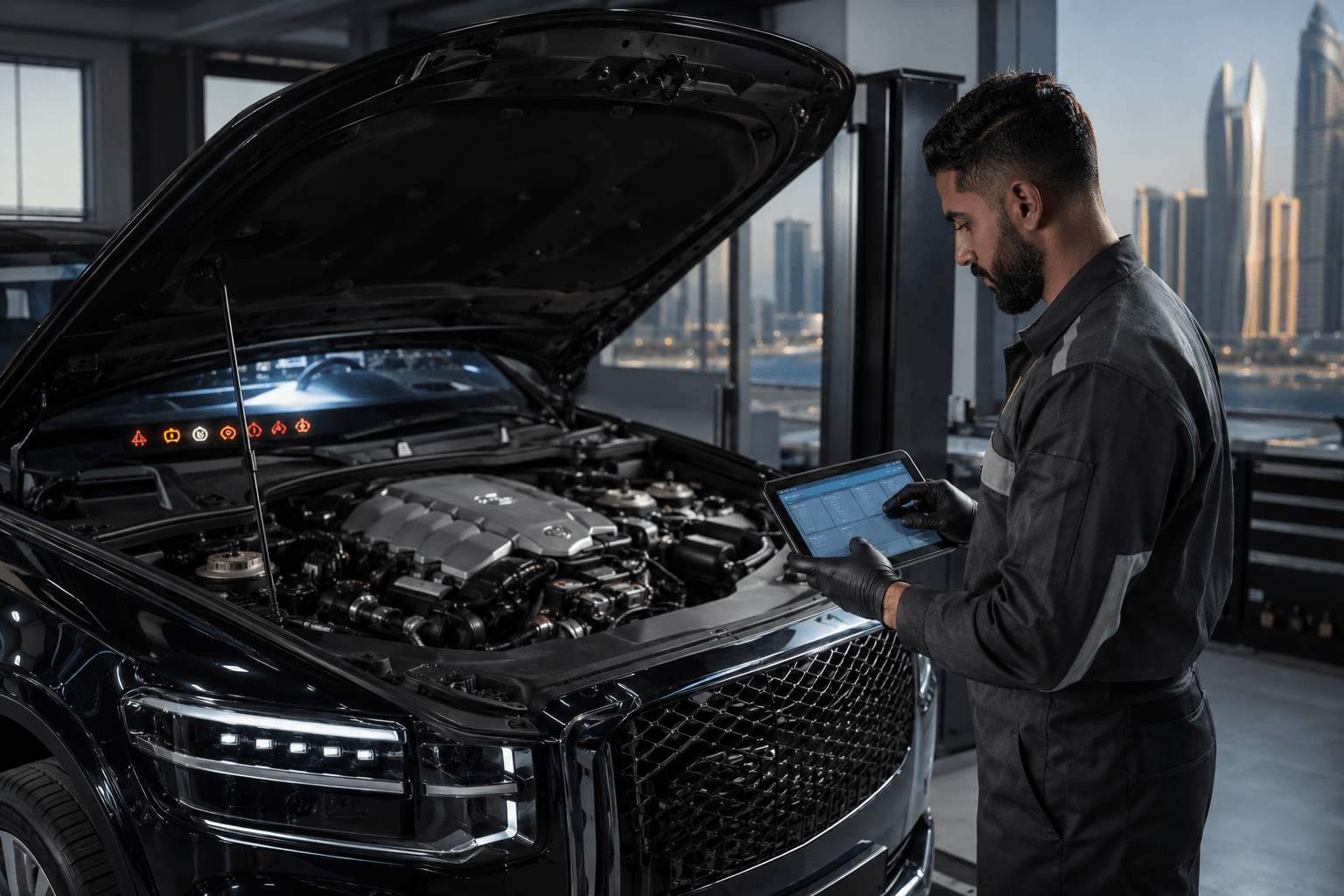
Cars rarely fail without warning. Prior to a major breakdown, the vehicle often provides alerts- little mechanical modifications that most drivers overlook due to the fact that the vehicle still remains in service. Strange noises, a warning light, slower reaction, or fluid spillage might not seem important at the time, but they are usually the initial signs of bigger mechanical problems brewing within the car.
In Abu Dhabi, heat, traffic, and long-distance driving add to the mechanical stress even more quickly. Engines are warmer, fluid pressures vary more rapidly, and worn parts wear out sooner when they are in a continuous heat cycle.
That is why it is not only a matter of repair but also of preventing it. When you know your car requires urgent mechanical service, it is the best way to avoid more extensive damage and save money.
The growth rate of vehicle issues in Abu Dhabi is higher due to the pressure on mechanical systems from climate factors. Small problems become bigger than they would otherwise be due to heat, distance on the road, and traffic patterns.
Main pressure points:
That is why frequent Car Service is more important in the conditions of UAE.
There are seldom instances when cars break down without notice. The vehicle tends to show early mechanical signs before a major breakdown occurs. The problem can develop much more rapidly in Abu Dhabi, given its heat and road conditions, and it is better to have a car serviced by a mechanic early to prevent costly repairs.
When the temperature gauge is consistently rising above normal, it might be a sign of a cooling system deficiency, inadequate coolant or radiator blockage, or internal engine stress. Lack of awareness of the heat rise may soon lead to overheating and, consequently, significant engine damage and costly repairs.
Rattling, knocking, ticking or grinding sounds are never normal. These sounds are usually an indicator of internal engine wear, low oil pressure, loose parts or bad parts. Small engine noises tend to appear first, but delaying inspection can often turn simple mechanical damage into severe engine issues.
Leakage of oil, coolant, brake fluid, or transmission fluid underneath the car is a direct indication of mechanical issues. Leaks lower the efficiency of a system, cause heat and may ruin the components around the system unless addressed. The loss of fluid should never be left unattended; it should be checked and repaired immediately.
The car's direct communication system is the dashboard warning lights. When the warning lights are still on, then it implies that the system must have already detected a mechanical or electrical problem. Overlooking them because the car continues to move normally usually postpones such repairs until the issue becomes severe.
When the engine is slow to boot or has difficulties with ignition, it tends to be a sign of battery weakness, a problem with the starter, a fuel problem, or an ignition problem. A delayed start typically worsens over time and may lead to total failure if ignored.
The significantly reduced acceleration response is a good indicator that there is a problem with engine performance, the fuel delivery system, airflow restriction, or ignition efficiency. When the car does not feel strong or is not as fast as it should be, it indicates that the mechanical system is not working as it should.
Things that are felt as a vibration in the steering wheel, seat or in the floor normally indicate that there is an imbalance in the wheels, wear on the suspension, a problem in the engine mount or a problem with the drivetrain. Driving without an inspection may strain associated mechanical components and make repairs costly.
When the brake pedal becomes softer, harder, or less responsive, it is generally due to a problem with brake fluid, pad wear, or an imbalance in the hydraulic system. The change in brake performance directly affects vehicle safety. Therefore, it must be considered a serious mechanical complication.
Poor AC performance may be a sign of a compressor problem, an electrical issue, or extra load on the engine that impacts system efficiency. During the Abu Dhabi heat, the sound of an air conditioner's abacus is easy to detect at the very beginning, yet the cause of the problem can lie deep within the workings of the machine and in electrical troubles.
Common smells one might experience while driving include a burning smell, which may indicate overheated oil or coolant leaks, overheated electrical wiring, or overheated brake components. Sensible smells should never be overlooked, as they often indicate real-time activity due to mechanical stress or component failure.
Not all warning signs carry the same urgency. There are those cases where urgent intervention is necessary, as they have a direct impact on safety or engine survival.
Mechanical issues tend to be costly due to slow response times. Most drivers observe the signs but take too long.
Preventive repair is cheaper than emergency repair.
Why?
Because of small problems:
Regular car mechanical service helps detect:
This transforms an emergency repair to planned repair. That saves money.
Automotive vehicles never break down without warning. The thing is, a lot of drivers pay no attention to the signs until the repair is necessary and costly. Elevated engine temperature, fluid spills, warning lights, brake adjustments, or strange noises are no coincidence, and they are early mechanical signals that must not be overlooked. Early action will protect the engine, enhance safety, and minimize future repair costs.
TyresWorld is one of the finest car repair shops Abu Dhabi and the most reliable car workshop in Abu Dhabi. We provide complete mechanical diagnostics, repair assistance, brake service, oil changes, battery replacement, and full vehicle maintenance.